Why Most AI Chatbots Are Just Glorified FAQ Bots — And How RAG Fixes It
Most AI chatbots fail because they're just FAQ bots in disguise. Here's how Retrieval-Augmented Generation (RAG) understands context, not just keywords.
 Shagun TyagiAI/ML Engineer, MBA (Product)
Why Most AI Chatbots Are Just Glorified FAQ Bots — And How RAG Fixes It
If you've talked to a "smart" chatbot on a business website and walked away annoyed, you're not wrong to be. Most of them aren't AI. They're decision trees wearing a chatbot costume.
The Problem: Keyword Matching Pretending to Be Intelligence
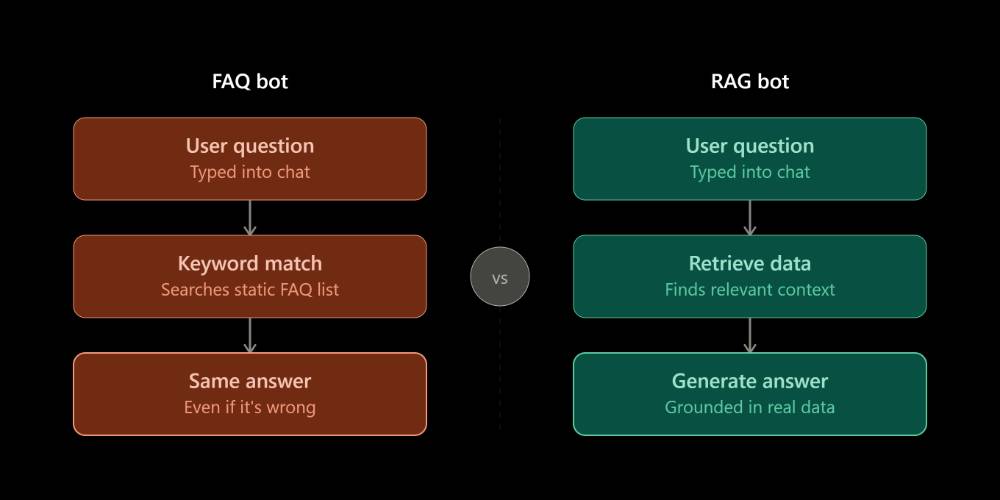
Here's what 80% of "AI chatbots" actually do under the hood:
- User types a question.
- Bot matches keywords against a pre-written FAQ database.
- Bot returns the closest static answer — even if it's wrong, outdated, or half-relevant.
- User rephrases. Bot still returns the same canned answer. User leaves frustrated.
This isn't AI. It's Ctrl+F with a chat UI on top. It breaks the moment a question doesn't match the exact phrasing someone wrote into the FAQ sheet six months ago.
The failure isn't the bot being "dumb" — it's the architecture. A keyword-matched FAQ bot has no understanding of context. It can't read a product catalog, a policy document, or a support ticket history and reason over it. It can only echo back what someone manually typed in advance.
What Actually Fixes This: Retrieval-Augmented Generation (RAG)
RAG changes the architecture in one fundamental way: instead of the bot guessing from a fixed answer sheet, it retrieves the actual relevant data first, then generates a response grounded in that data.
This isn't a new idea — it was formalized in a 2020 Meta AI research paper that introduced the term, and it's since become the standard approach for grounding LLMs in real, current data instead of relying on what they memorized during training.
The pipeline looks like this:
- Ingest — Your documents (product docs, policies, past tickets, knowledge base) get chunked and converted into vector embeddings.
- Store — Those embeddings live in a vector database (ChromaDB, Pinecone, etc.).
- Retrieve — When a user asks something, the system searches the vector store for the most semantically relevant chunks — not keyword matches, meaning matches.
- Generate — An LLM (GPT, Gemini, Claude, etc.) takes those retrieved chunks plus the user's question and writes a grounded, contextual answer.
The difference in practice: a FAQ bot fails on "do you guys still take returns after a month" if the doc says "30-day return policy." A RAG-based bot understands those mean the same thing, retrieves the actual policy text, and answers correctly — because it's reasoning over real content, not pattern-matching exact phrases.
This Isn't Theoretical — It's What I've Been Building
I've built multi-turn RAG systems where the bot doesn't just answer once and forget — it holds context across a conversation, retrieves relevant documents on the fly, and summarizes long documents into usable answers in real time. No static script. No "I don't understand that, please rephrase" loop. Just retrieval, grounding, and generation, working together.
That's the actual bar for "AI chatbot" in 2026. If it can't retrieve and reason over your real data, it's not AI — it's a glorified search bar with extra steps.
The Takeaway
If you're evaluating a chatbot for your business — or building one — ask one question before anything else: "Is this retrieving real data, or matching keywords against a script?"
If it's the second one, you're buying a 2015-era FAQ widget with a 2026 price tag.
Building a RAG-based chatbot for your business and need it scoped, priced, or built? I build exactly this — WhatsApp bots, support bots, internal knowledge bots. DM me or drop a comment.
FAQ
Q1. What's the difference between a regular chatbot and a RAG chatbot? A regular chatbot matches user input against pre-written answers (keyword/rule-based). A RAG chatbot retrieves relevant data from your actual documents or database in real time, then uses an LLM to generate a contextual answer grounded in that data.
Q2. Do I need a huge dataset to use RAG? No. RAG works with as little as a few dozen documents — product pages, FAQs, policies, support tickets. The retrieval step just needs relevant content, not large volume.
Q3. Is RAG expensive to build and run? Not for most small-to-mid businesses. A lean RAG stack (open-source vector DB like ChromaDB + a cost-efficient LLM like Gemini Flash) can run for a few dollars a month in inference cost at low-to-mid volume. Cost scales with usage, not with setup complexity.
Q4. Can RAG hallucinate or give wrong answers? Less than a plain LLM, but yes, it's possible if retrieval pulls weak or irrelevant context. Good chunking, embedding quality, and retrieval tuning (top-k, reranking) reduce this significantly. It's not zero-risk — it's lower-risk than an ungrounded LLM or a static FAQ bot.
Q5. What platforms can a RAG chatbot run on? Anywhere you can embed a chat interface or API call — website widgets, WhatsApp (via Business API), Slack, Telegram, internal dashboards. The retrieval + generation logic is platform-agnostic; only the front-end channel changes.
Q6. How is this different from just using ChatGPT directly? ChatGPT (without RAG/plugins) only knows what it was trained on — it has no access to your specific business data, current inventory, or live policies. RAG is what bridges that gap: it makes the LLM answer using your actual, current information instead of general training knowledge.
Q7. How long does it take to build a RAG chatbot for a business? A scoped, single-use-case RAG bot (e.g., one product line, one support domain) typically takes 1-3 weeks depending on data cleanup needs and integration complexity (WhatsApp Business API approval alone can add time).
Ask this article